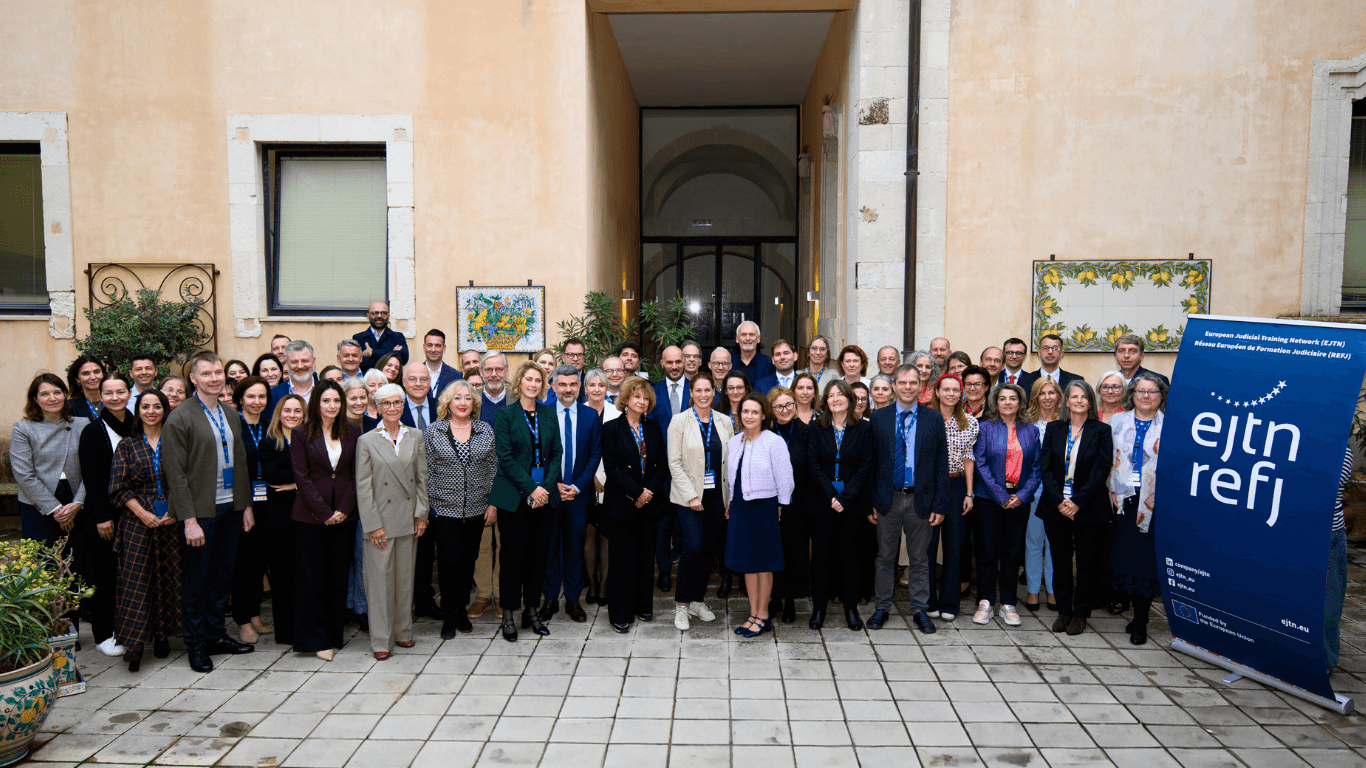
Bringing together 76 participants from across Europe, selected by a random draw from more than 1,200 applicants, the fifth edition of the Judges@Europe Forum took place from 3 to 6 November 2026 at the Siracusa International Institute for Criminal Justice and Human Rights in Syracuse, Italy. Organised annually by the European Judicial Training Network (EJTN), this year’s Forum offered participants a confidential space under the Chatham House Rule to discuss judicial well-being, working conditions, security, and independence, and to develop shared conclusions for a joint Forum Statement.
Reflecting the strategic importance of these issues for European justice systems and justice practitioners, the Forum benefitted from the contributions of high-level representatives from key European and international institutions, including Laura Codruța Kövesi, former European Public Prosecutor’s Office (EPPO) Chief Prosecutor. Their participation, alongside that of representatives of judicial institutions from across Europe, underscored the growing recognition that judicial well-being, independence, and resilience are matters of concern across the European judicial community.
This year’s theme, “Well-being and Welfare of Judges in Connection with Judicial Independence and the Rule of Law”, drew on the findings and recommendations of Opinion No. 28 (2025) of the Consultative Council of European Judges (CCJE) on the importance of judicial well-being for the delivery of justice. The Opinion highlights the role of judicial training in raising awareness of the challenges that can affect judges’ well-being and promoting appropriate support mechanisms. It specifically underlines the contribution of training initiatives at both national and European levels, including those delivered through EJTN.
Against this backdrop, the Forum explored judicial well-being and welfare through discussions on working conditions, judicial safety, court leadership, digitalisation, workload, and burnout prevention. Through a combination of keynote speeches, panel discussions, and interactive workshops, participants examined these challenges from both individual and institutional perspectives.
In her keynote speech, former European Public Prosecutor’s Office (EPPO) Chief Prosecutor Laura Codruța Kövesi focused on the pressures faced by judges, stressing:
“Judicial independence is truly tested when investigations reach powerful interests and judges and prosecutors face pressure, intimidation, or personal attacks simply for doing their duty. The greatest challenge is not always the physical threat, but the constant pressure designed to undermine their credibility and make them question whether doing their job is worth the personal cost.
We cannot ask them to be courageous, independent, and impartial while leaving them alone when they become targets. Judicial independence cannot depend on individual courage alone. Protecting those who defend the Rule of Law is not a privilege. It is a fundamental responsibility of the State.”
Jean-François Thony, President of the Siracusa International Institute for Criminal Justice and Human Rights, emphasised the shared responsibility to support those entrusted with upholding the Rule of Law:
“The Rule of Law is only as strong as the institutions and individuals entrusted with upholding it. Judicial independence cannot be taken for granted, nor can it rest solely on the personal resilience of judges and prosecutors. It requires sustained institutional commitment, adequate working conditions, and a culture of respect for the judiciary. Protecting judicial independence also means protecting those who exercise it, ensuring that they can fulfil their responsibilities with integrity, confidence and freedom from undue pressure.
This Forum offers an important opportunity to reaffirm our shared responsibility to support judges, strengthen mutual trust and ensure that justice remains independent, accessible and firmly grounded in the Rule of Law.”
EJTN Secretary General, Judge Ingrid Derveaux, highlighted the importance of judicial well-being and working conditions in safeguarding judicial independence and the Rule of Law:
“This is a particularly timely discussion, as the conditions in which judges work and carry out their responsibilities form an important part of the wider environment in which the Rule of Law is upheld.
Judicial independence depends not only on institutional safeguards, but also on judges’ daily working conditions. Well-being, security, professional support, and sustainable workloads are essential safeguards that enable judges to exercise their functions impartially, effectively, and without undue pressure.
Across Europe, judges are working in an increasingly demanding environment, shaped by digitalisation, rising caseloads, public scrutiny, and complex legal challenges. Supporting them in navigating these pressures is essential to maintaining public confidence in justice and safeguarding the Rule of Law.”
The Judges@Europe Forum was created in response to the Council Conclusions of 11 March 2021, Boosting Training of Justice Professionals. The Conclusions called for stronger dialogue among judges to consolidate the Rule of Law and foster a common European judicial culture. Since its launch, the Forum has generated valuable resources for the European judicial community, including the publication The Rule of Law and the Good Administration of Justice in the Digital Era and ‘Judges Upholding the Rule of Law Crash Course’, created in collaboration with the Council of Europe’s HELP Programme. Both resources were developed following the 2023 edition and address challenges facing judges in today’s increasingly digital environment.
The Forum is the result of a collaborative effort, made possible through the commitment and contributions of the ad hoc group members of the EJTN Working Group on Programmes: the Spanish Judicial Training School, the Romanian National Institute of Magistracy, the French National School for the Judiciary (ENM), the Academy of European Law (ERA), the German Federal Office of Justice, the Belgian Judicial Training Institute, and the Greek National School of the Judiciary.
EJTN extends its sincere thanks to the European Commission for its invaluable support in funding the implementation of this project.
EJTN also thanks all speakers and moderators for their contributions to this year’s Forum, and the Siracusa International Institute for Criminal Justice and Human Rights for hosting the event.
List of contributors:
Laura Codruța Kövesi, former European Chief Prosecutor, European Public Prosecutor’s Office (EPPO)
Stelios Bios, Presiding Judge, First Instance Court of Larissa, Greece; Convener of the EJTN Civil Law Sub-Working Group
José Pablo Carrera Fernández, Judge, Convener of the EJTN Working Group on Programmes; Head of the Judges@Europe Forum 2026 Task Force
Ingrid Derveaux, Judge, Secretary General of the European Judicial Training Network (EJTN)
Meelis Eerik, Chairman, Harju County Court
Ramona Frendo, Judge, Court of Justice of the European Union (CJEU)
Nicolas Guillou, Jurist and sitting judge, International Criminal Court (ICC)
Mariarosaria Guglielmi, President, Magistrats Européens pour la Démocratie et les Libertés (MEDEL)
Emmanuelle Laudic-Baron, Deputy Director and Head of the International Department, French National School for the Judiciary (École nationale de la magistrature, ENM)
Sabine Matejka, President, European Association of Judges (EAJ)
Madeleine Mathieu, Member of the Executive Board, European Network of Councils for the Judiciary (ENCJ); Member, Conseil supérieur de la magistrature (CSM), France
Amelia Onisor, Judge and Trainer, National Institute of Magistracy (NIM), Romania
Michalis Pikramenos, President, Council of State of Greece
Raffaele Sabato, Judge, European Court of Human Rights (ECtHR)
Lorraine Schembri Orland, Judge, European Court of Human Rights (ECtHR)
Silvana Sciarra, Jurist and former Judge, Constitutional Court of Italy
Aleksandrs Switalska, Senior Policy Advisor, European Network of Councils for the Judiciary (ENCJ)
Jean‑François Thony, President, Siracusa International Institute for Criminal Justice and Human Rights
Viktor Vadasz, Director of Programmes, Academy of European Law (ERA)
Petra Wagner, Judge, Federal Patent Court (BPatG), Germany
For more information on this prestigious platform, please visit the dedicated Judges@Europe website.
To receive the latest updates from EJTN, follow us on LinkedIn and subscribe to our newsletter.